Since the mid-1970s, conservationists, planners and land managers have been directing their attention to the formation of regional biolinks as an intuitively appealing way of slowing the decline of biodiversity in Australia, a continent that has lost over 40% of its forests since colonisation – 70 to 80% in states like Victoria.
Also known as greenways, green belts, shelterbelts and wildlife corridors, the biolink concept resonates because it is easy to understand.
In his highly influential book, Linkages in the Landscape, La Trobe University conservation researcher, Andrew F Bennett, notes the appeal of biolinks as โa visible solution to a visible problem – habitat fragmentation is generally a strikingly-obvious process. Equally, habitat corridors are a visible sign of efforts to โmendโ the fragmented landscape (โbandages for a wounded natural landscapeโ – Soulรฉ and Gilpin 1991).โ
He also notes that the ability to establish biolinks at different scales gives local communities the feeling they can โdo something aboutโ the damage in their local environment and see visible results.
Department of Climate Change, Energy, the Environment and Water diagram showing landscape elements that contribute to wildlife corridors.
Gondwana Link project in south-western Australia.
Do biolinks actually work?
The rapid uptake of biolink projects around the world initially outpaced scientific understanding and data collection. Questions were raised about their effectiveness, particularly given the scarcity of conservation resources. Multiple studies were conducted looking at the key domains of:
Landscape connectivity – the physical connections between habitats across a landscape.
Habitat connectivity – connections between patches of habitat (โstepping stonesโ) suitable for specific species.
Ecological connectivity – the function of ecosystems across space and time.
Evolutionary connectivity – allowing populations to interact naturally, breed and strengthen genetic diversity.
In 2010, the first meta-analysis was published. It showed that corridors increase migration between habitat patches by as much as 50%. Ten years later, a second analysis was done to solve questions raised in the first analysis. It found that, although not all corridors worked as planned, overall corridors effectively increase species movement, fitness and richness. This further translated into an increase in community biodiversity.
Macro (large scale) biolinks
Beginning in the early 2000s, up to a dozen large-scale biolinks were proposed or established in Australia, one of the earliest being the Gondwana Link project in south-western Australia. Conceived by a small group of conservationists in 2000, the program now coordinates dozens of separate conservation projects along a 1,000 km corridor from the forests of Margaret River to the semi-arid woodlands and Mallee country bordering the Nullarbor Plain.
In 2005, Greening Australia began shaping up its Habitat 141 project; a 50-year collective response to habitat fragmentation and climate change along the 141st longitude stretching from the coast of South Australia, along the Victorian border, and up to the rugged rangelands of New South Wales.
Noting the success of these and other projects and how they might be connected to the National Reserve System (a network of more than 10,000 Commonwealth, state and territory protected areas) in 2012, the Australian Government published a National Wildlife Corridors Plan. Information on that plan is now difficult to find online. The program appears to have been folded into one of the most ambitious initiatives of all โ the Great Eastern Ranges biolink.
This impressive program seeks to conserve and manage a 3,600 km โcontinental lifelineโ of habitats, landscapes and people from the Grampians in western Victoria, along the Great Divide and Eastern Escarpment of New South Wales and the Australian Capital Territory, to the wet tropics and remote Cape York Peninsula in Queensland’s far northeast.
Over 250 regional, state and national organisations have chosen to align their activities with the GER vision. Among them is the Biolinks Alliance, which performs a unique role as a capacity and partnership-building organisation consisting of 18 member Landcare networks working mostly in Central Victoria.
The missing link โ community-based conservation
Australian National University researcher Carina Wyborn has been studying conservation connectivity since the early 2000s. Many of the themes she discusses in her publications discuss the challenges of collaboration.
โWithout people working together, connectivity initiatives will go nowhere (Lovett et al. 2008), thus collaboration and community-based conservation are central.
โCentred in an ethic of place, community-based conservation is underpinned by the premise that local populations have a greater interest in and knowledge of local contexts โฆ further, โby placing these local contributions within a larger picture (e.g large-scale programs), gives conservation on private land greater purpose.โ
Paddock-scale connections
For decades, individual landholders have been working with organisations like Landcare to restore and protect pockets of habitat on private land. This work is critical, given that over 60% of all land in Australia is privately owned or managed (farms, pastoral leases and mines) and that 70% to 90% of inadequately protected wildlife is found on private land.
However, it has sometimes been difficult to see these activities within a broader vision.
Given their commitments to sustainability and better environmental management, many councils are stepping up to fill critical gaps, offering incentives to landholders and practical tools such as maps. A great example of this is Cardina Shire Councilโs interactive map, which shows what has been done and what opportunities there are for improvement.
BioDiversity Legacy is also working with landholders and organisations across Australia, like Land Covenantors Victoria and Prom Coast Ecolink, to promote the connection of private landholdings and consider how they too can be tied into the vision we all share โ protecting and connecting land for conservation and threatened species.
Wildlife Unlimited, in partnership with local landholders and mentored by BioDiversity Legacy, is leading the Helping Hands for the Sheoak project – an ambitious effort to restore stands of Sheoaks (Allocasuarina littoralis) on private land across East Gippsland.
These plantings aim to increase the availability of feed trees for the nationally endangered Glossy Black-cockatoo (Calyptorhynchus lathami), a species that depends almost exclusively on Sheoak seeds for food.
Supported by the Natural Resource Conservation Trust (NRCT) and the Rendere Environmental Trust, the project brings together an active network of collaborators, including local landholders, the Far East Victoria Landcare Group (FEVL), Moogji Aboriginal Council and the Friends of Mallacoota.
A closer look at the project
In May 2025, BioDiversity Legacyโs Community & Stewardship Manager, Robyn Edwards, visited two participating properties and toured the Moogji Aboriginal Council Nursery, where Sheoaks destined for future Glossy Black-cockatoo habitat are being carefully propagated.
Sheoaks are remarkable, drought-tolerant trees with fine, needle-like foliage and distinctive woody cones. But they are also slow to mature; trees can take up to 10 years to produce cones containing the seeds that Glossy Black-cockatoos extract and even longer before their branches are sturdy enough to support feeding birds. Glossies are highly selective, returning year after year to particular female feed trees within a stand.
At the Moogji Nursery, Misty Anderson has been collecting seed from Sheoaks where Glossies have been observed feeding. By propagating seedlings from known feed trees, the team hopes to better understand potential genetic traits that may improve long-term revegetation success.
A highlight of the planting day in Genoa was a Glossy flying over the planting site. Photo by Peter Murrell.Misty Anderson (left), Moogji Aboriginal Council Nursery and Esther Gatnau from Wildlife Unlimited with Sheoak seedlings.Mature Sheoak tree. Photo by Robyn Gower. Helping Hands team members (l to r): Les McLean (Natural Resource Conservation Trust), Loulou Gebbie Biodiveristy Legacy, Josh Puglisi FEVL and Jim Phillipson, Rendere Environmental TrustSheoak cones. Photo by Robyn Gower.Planting day, Geroa. L (back) to r: Amelia, Fred, Esther Gatnau, Dixie Fitzclarence, Ted Dexter and Fred Jnr.
Building on earlier recovery work
This project builds on extensive Sheoak regeneration and Glossy Black-cockatoo recovery efforts undertaken by Landcare, BirdLife and the Department of Energy, Environment and Climate Action following the 2019โ20 Black Summer Bushfires. New project sites now stretch from Lakes Entrance and Marlo, across to Wangarabell and Genoa in the far east.
Community conservation in action
The project is also creating opportunities for the community to get involved. At a recent planting day on Ted Dexterโs farm in Genoa, young conservationists Freddie and Amelia – and their parents – spent the day planting and guarding Sheoaks alongside other volunteers.
โIt is very inspiring when the younger generation turns up to help at a planting day,โ said BioDiversity Legacyโs Head of Conservation Engagement & Partnerships, Dixie Fitzclarence. โIt provides a measure of hope for the future.โ
Around 10 years ago, former Melbourne schoolteacher Stuart Inchley and policymaker Victoria Johnson stumbled across a 300+ acre property for sale in the hills of South Gippsland (historically known as Land of the Lyrebird).
With a passion for conservation, sustainability and climate justice, the couple made the life-changing decision to purchase the property, place a conservation covenant on it and act on its behalf as land stewards.
It took several years for Stuart and Victoria to properly survey the property, which is characterised by dense bush, cool temperate rainforest and steep terrain, learn about local species and appreciate just how unique it is.
At first, he thought there were maybe a few dozen, but with local ecologists from Gippsland Threatened Species Action Group and elsewhere, Stuart and Victoria have now counted hundreds of individual plants. Given estimates suggesting that just 1,000 are left in Victoria, this is a major find that is attracting interest nationally and internationally.
Listen to leading Victorian ecologist, Karl Just, describe South Gippsland’s rainforests and species found within the Tarwin River Forest.
Back to reality
Unfortunately, Stuart and Victoriaโs elation and finding so many Slender Tree-ferns was short-lived. Within just a few weeks, they heard chainsaws and logging activities in the property next door.
These actions, by HPV Plantations โ the largest private plantation company in Australia โ came within a few metres of the couple’s fenceline; too close for comfort for the ferns, which can easily be damaged by exposure to wind, rain and other elements. Stuart and Victoria felt they had no choice but to launch a campaign to stop these actions, garnering huge community support through their Gippsland Forest Guardians website (*story update – the campaign was successful!).
Partnerships for protection
With Gippsland Threatened Species Action Group (GTSAG) and other groups, Stuart and Victoria are also running campaigns to protect the last remnants of Cool Temperate Rainforest in South Gippsland, home to unique native species such as Gang-gangs, Powerful Owls, Pilotbirds, the rare and endangered Strzelecki Burrowing Crayfish and Strzelecki koala.
These rainforests, which are dominated by Myrtle Beech, Southern Sassafras, Blackwood and eucalypts with a thick understorey of tree and ground ferns, exist in high rainfall, higher altitude, fertile environments. While they can still be found across Victoria, land clearing, fire and logging have reduced the amount of these forests in Victoria to a mere 0.08% of the stateโs total area and are now listed as a threatened community under the Victorian Flora and Fauna Guarantee Act (1988).
In partnership with Prom Coast Ecolink and local landholders, in 2024, GTSAG received a generous grant from the Wettenhall Environment Trust to undertake a mapping survey of Cool Temperate Rainforest on Stuart and Victoriaโs property and three adjoining Trust for Nature properties (totalling over 850 acres) to map the distribution of Slender Tree-ferns.
Weโre all behind Stuart and Victoria and the commitment they have made to protecting the environment and building connections with the local community to raise awareness of BioDiversity Legacy and the need to strengthen local biolinks.
Through necessity, the early settlers viewed the Australian landscape through an economic lens, assessing the natural value of the land in terms of what they could extract from it.
Now, as we shift our focus to natural capital โ the air, water, soil, plants and animals that essentially keep us alive โ we are beginning to value more diverse landscapes. But not all get the attention they deserve.
A case in point are the muddy, mucky landscapes known as coastal saltmarsh. Despite providing an astonishing array of ecosystem services, they remain greatly undervalued. But why?
Blue carbon landscapes
Broadly defined as a mosaic of coastal ecosystems, saltmarsh is one of the most productive ecosystems on Earth, likened to kidneys or lungs in terms of its ability to filter pollution and intercept nitrogen run-off from farms.
In South Gippsland, Victoria, this lung effect can be seen from above as we look down at the 67,186-hectare site of Corner Inlet. Adjacent to Wilsons Promontory and the Nooramunga Marine and Coastal Park, Corner Inlet is one of 64 wetland areas listed as a Wetland of International Importance under Ramsar Convention.
Fringing the Inlet and the 40 plus sandy barrier islands within the inlet are some of the most floristically diverse coastal saltmarshes in the country; marshes that not only reduce farm run-off and provide a nursery for young fish, but capture and store carbon at rates 30-50 times higher than the equivalent area of soil in terrestrial forests โ a process known as blue carbon.
Listen to Nooramunga Land & Sea Botanist, Karl Just, talk about key saltmarsh species.
Reframing notions of value
According to Melbourne University wetland ecologist, Paul L. Boon, Australians have always undervalued saltmarsh. He uses the folktale of Cinderella to describe how they are perceived as the ugly or poor stepsister of inland wetlands – wastelands standing between us and our desire to live on the coast and extract resources from it.
Viewed through European eyes, saltmarshes certainly ainโt pretty; in Cinderellaโs words, โWhen they look at me, they see a messโ.
But if you look closer you can see the jewels in the landscape, like the samphire or glasswort whose jointed branches look like strings of coloured beads. Or the red seablite that mixes with the samphire to create rivers of red marsh.
A population at risk
While Corner Inlet retains 80% of its saltmarshes, a salutary lesson can be learned if we look west to Anderson Inlet, where 60% of the marshes have been lost. Or further north to Botany Bay โ ironically named for its biodiversity โ where losses in some areas are reported as 100%.
However, some plants within the Corner Inlet, including the iconic grey or white mangrove, are endangered. Perversely, if the saltmarshes are not managed well, the system gets out of balance and mangroves take over. So these systems need to be managed carefully.
An island of hope
In 2022, leading Victorian botanists Tim D’Ombrain and Karl Just got wind of a potential sale of Little Dog Island off the coast of Hedley within Corner Inlet.
Little Dog Island photo with thanks to Andrew Wallace.
Formerly owned by a group of developers who attempted to build an eco-resort on the island – complete with 9-hole golf course – the 62-hectare island was abandoned when the project failed. It lay idle for 14 years until Tim and Karl invited Federation University paleoecologist Professor Peter Gell, Rendere Environmental Trust Strategic Director Jim Phillipson and Carbon Landscapes co-director Dr Steve Enticott to collaborate on a new conservation project.
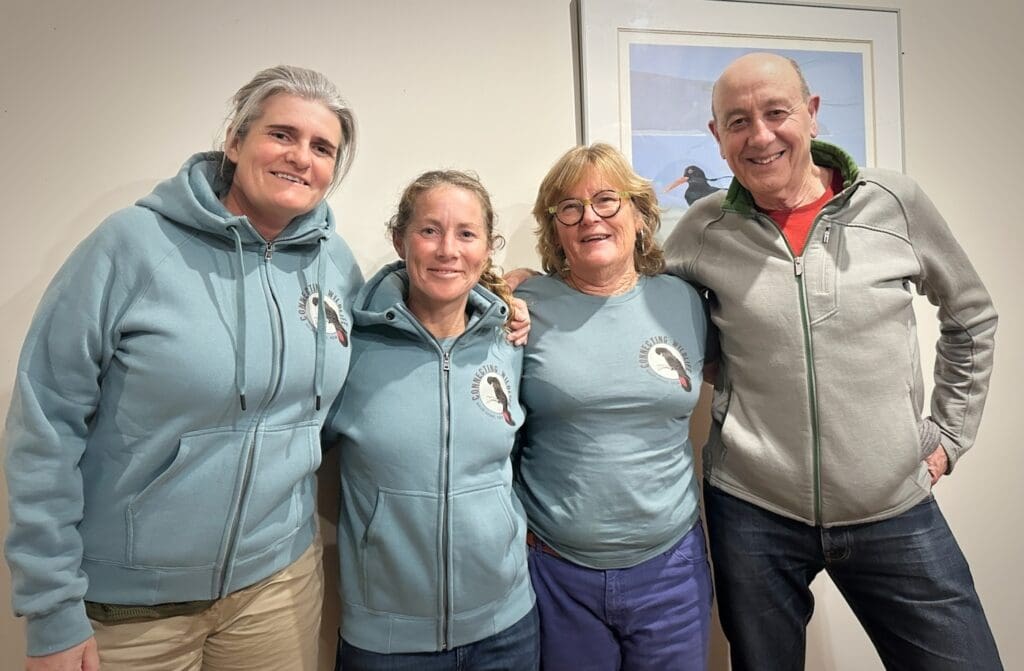
Together they formed a not-for-profit organisation called Nooramunga Land & Sea to hold the island in trust for future generations with provisions to enable community engagement and collective land stewardship.
The โsaltmarsh crewโ are now repairing damage caused by the development and eradicating feral animals and weeds. Theyโre also investigating opportunities to secure other private properties in the area.
โWe see these landscapes as ecological gems in the jewel that is Corner Inlet,โ says Jim Phillipson. โThey are beautiful and highly productive landscapes that support human health and wellbeing. But they are fragile and easy to disrupt. To protect them, we need to value them and promote their intrinsic value โ just by being left alone.โ
Like other areas within the Inlet, Little Dog Island attracts a wide range of migratory birds. It may also provide habitat for the critically endangered Orange-bellied Parrot, which feeds on plants that grow in salty or alkaline conditions, such as saltmarshes.
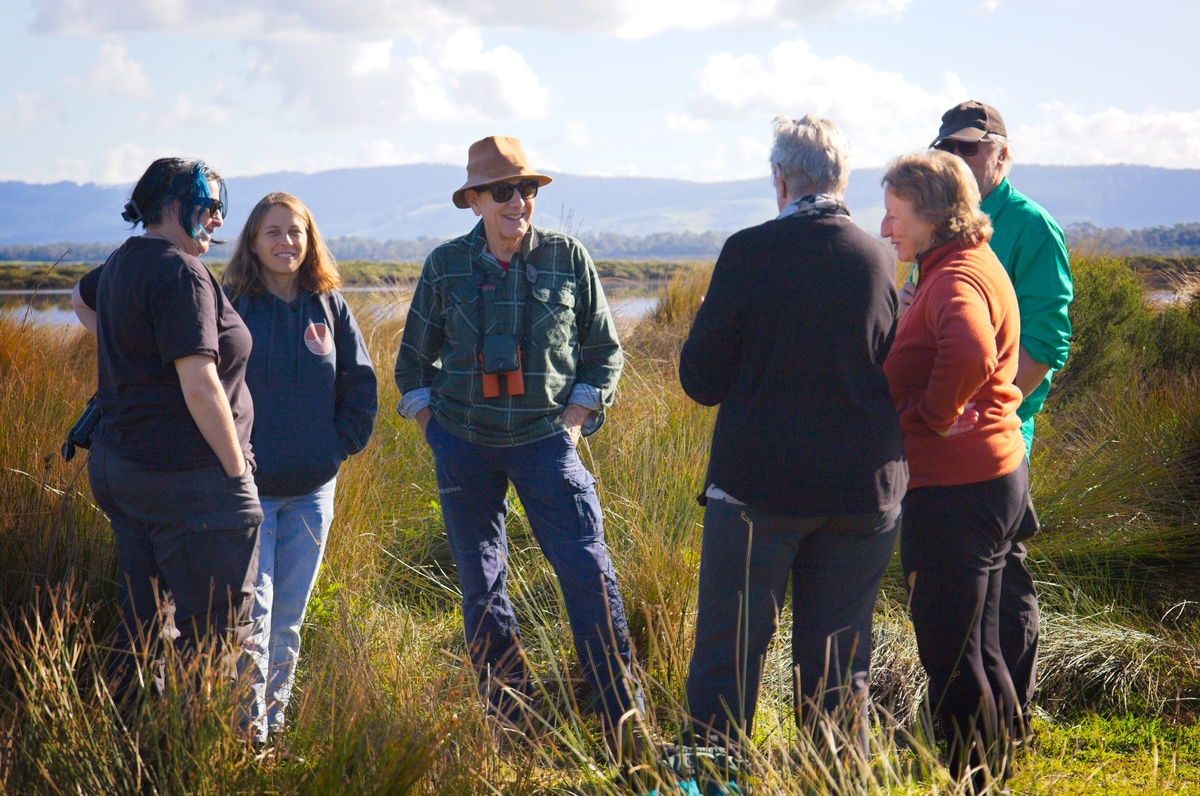
Expectations are high that the Parrot will be spotted on Little Dog Island, with members of the conservation crew participating in BirdLife Australiaโs Winter Surveys. The crew are also exploring opportunities to secure other properties in the Inlet to build biolinks and connections for plants, animals and people.
With thanks to Professor Paul Boon, whose research on saltmarsh is published in the CSIRO journal Marine & Freshwater Research and Royal Botanic Garden Sydney journal, Cunninghami