Across Australia, private landholders are playing an increasingly active role in restoring and protecting habitat.
At BioDiversity Legacy, we work closely with people who may already have conservation covenants on their land or are deciding whether to do so.
Alongside this, our Local Landholding Entity (LLE) model offers another pathway to permanent protection, transferring land into a dedicated, community-led not-for-profit structure.
These approaches are not competing solutions. Rather, we see conservation covenants as complementary to the protections enabled through the LLE model, together strengthening Australia’s private land conservation estate.
Understanding what motivates landholders to choose these pathways – and what supports them to care for land over the long term – is essential if Australia is to meet its biodiversity commitments.
To help inform our work, we regularly engage with sector partners, including the Australian Land Conservation Alliance and Land Covenantors Victoria (LCV).
Recently, LCV hosted two leading researchers, Dr Carla Archibald and Dr James Fitzsimons (The Nature Conservancy), who shared local and global insights into landholder motivations for covenanting and the policy settings needed to scale impact.
This two-part blog series explores those insights. In this first piece, we focus on Dr Archibald’s research into why landholders adopt conservation covenants and what drives long-term stewardship. A second article, to be published in March 2026, will examine Dr Fitzsimons’ research on the urgent role governments must play if conservation covenants are to help Australia meet its national biodiversity goals.
What are covenants?
Before we delve into this exploration, let’s start with the basics. What is a covenant?
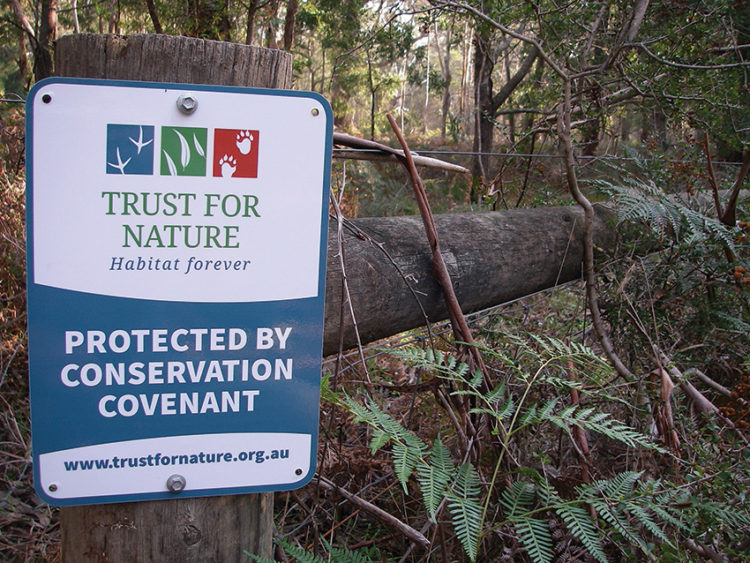
A conservation covenant is a voluntary, legally binding agreement between a landholder and an authorised body to protect and care for land with important natural, cultural and/or scientific values.
The landholder retains ownership and can continue to live on and use the land, while agreeing to manage all or part of it in ways that conserve its identified values, in partnership with the authorised body.
Authorised bodies (often called covenant scheme providers) may include not-for-profit organisations, government agencies or local councils that have the authority to enter into conservation covenants with landholders; for example, Trust for Nature in Victoria, Biodiversity Conservation Trust in NSW and the Tasmanian Land Conservancy (TLC).
Why landholders choose conservation covenants – insights from Dr Carla Archibald’s research at Deakin University
For more than a decade, Dr Archibald has studied private land conservation and the social dynamics behind environmental behaviour. Her recent research – based on a survey of 475 landholders in New South Wales – asked a simple but powerful question: What drives someone to commit their land to long-term conservation?
Conservation is already happening quietly, everywhere
One of the most striking findings of the survey is just how widespread voluntary conservation already is in NSW. Over 80% of surveyed landholders were actively undertaking conservation management – weed control, revegetation, pest and feral animal control – independent of any formal agreement.
Only 15% of those surveyed had a legally binding conservation covenant, but another 39% were involved in programs such as Land for Wildlife. This suggests an enormous, untapped pool of landholders who are already engaged but may need additional support, confidence or incentives to take the next step.
The four key influences on covenant adoption
Dr Archibald’s research identified four strong drivers:
1.Existing conservation engagement
Landholders already actively caring for their land were eight times more likely to adopt a covenant. This points to a progressive pathway: care – commitment – covenant.
“People who are passionate about conservation are the ones willing to make a permanent commitment,” said Dr Archibald.
2.Time and capacity
Those with more time to undertake stewardship were 1.6 times more likely to covenant their land. Surprisingly, retirement status did not influence adoption suggesting time, not age, is the real barrier.
3.Suitable land available
Landholders who knew they had ecologically valuable or suitable areas were twice as likely to adopt. Property size itself didn’t matter. Agencies could therefore target properties with high conservation potential – focusing on ecological fit, not acreage.
4.Income and incentives
Financial incentives ranked lower than expected. However, landholders earning income from their land were more likely to adopt covenants. This shows:
- Conservation can co-exist with primary production
- Environmental markets in NSW are making conservation a sound business proposition
- Conservation actions can enhance farm productivity and ecosystem services
A pathway that supports livelihoods and landscapes
The overarching message from Dr Archibald’s research is clear: Covenants are most successful when they align biodiversity outcomes with the social and economic realities of landholders.
Programs that acknowledge landholder capacity, income reliance and ecological assets have the best chance of expanding uptake.
She noted that policymakers are increasingly recognising this and praised LCV’s successful advocacy work – particularly the push for land tax exemptions for covenantors.
Looking ahead, Dr Archibald hopes to explore how sustainable finance mechanisms could underpin long-term conservation and community resilience.